 |
GREATDANELADY.COM Linda Arndt ~ Canine Nutritional Consultant Email:  |
 |
Bloat and Torsion in my Pet |
|
Preface:
If you are concerned about bloat, and want to keep your dog on a program that will help to prevent it, I recommend using CORE 4 Kit #40 BLOAT and choose a food from my list of better foods. REMEMBER NOTHING IN LIFE IS A GUARANTEE AND MANY FACTORS ENTER INTO THIS BLOAT SITUATION, BUT WE CAN SUPPORT THE SYSTEM THE BEST WE CAN WITH A HOLITIC DIET AND SUPPLEMENTS THAT KEEP THE DIGESTIVE TRACT IN GOOD SHAPE. CORE 4 KIT#40 - BLOAT The kit and supplements can be shipped overseas priority mail. The use of this kit or these supplements is no guarantee your dog will not bloat. The cause is unknown and multi factored, however the supplements will aid in your dogs digestive health, and hopefully with a good nutritional program we can maintain overall wellness. All the information in this article can be found at www.GreatDaneLady.com including the live links that are lost in publishing this as a hard copy Click here for a :BLOAT AND TORSION SYMPTOM CHART Introduction: I would like to take a look at the potential role diets can play in the cause of bloat/gastric torsion. I refer to these as two separate issues because we can have bloat without torsion, as well as spleen torsion without any bloating or stomach torsion. The topic of bloat and/or torsion conjures up a multitude of feelings for any individual who has had first hand experience with this condition. The feelings of frustration and helplessness are only compounded by the fact that there has been no valid research information, on the cause or prevention of this condition. Some of the reports about the Purdue Bloat Study are very misleading to lay individuals because it presents itself as scientific research, when in fact it is only statistical research. The information that was often posted about bloat at the Purdue website was not what we refer to, in academic communities, as peer evaluated. The problem is the average dog owner does not know this and then believes the information put out on the internet as science and truth. For a further explanation of the validity of this research, read my article on the Purdue paper. Debunking Myths on Dog Bloat and TorsionOver the years we have heard "theories" about the cause of bloat, and the internet has helped to keep these myths/ theories alive and well in 2013. We have been told to watch the excessive consumption of water, particularly after exercise, to me this is just common sense, after all we do not jog or swim after a full meal. Then we were told to soak food before feeding to see if it swells, which we now know is WRONG because soaking actually destroy nutrients and destroys any beneficial bacteria sprayed on the outside of the food. Then it makes it worse because the swelling of the kibble has NOTHING to do with bloat other than the soaking or hot water has killed off most of the nutrition. (keep in mind you should never soak puppy food either..put the kibble through a food processor or blender to get a powder, then mix your liquid with it to make a porridge for your weaning babies. Add additional probiotics to this mixture as well because they are born with a sterile GI tract.) Then we have the controversy over the use of saponins in beet pulp (Beet Pulp Myth), which is not based in any scientific research and was generated by a dog food company in the 1970's and they still generate this antiquated and false myth. Of course there is the theory of pelletized foods vs baked foods being a problem, which is absolutely ludicrous because no matter how you view it both are cooked processed foods and absent of vital dietary enzymes needed to help prevent bloat. The air swollowing theory makes no sense at all, and is just a grasp at something to point a finger at as the cause. The latest myths generated were regarding citric acid, a natural preservative, when in fact citric acid in the gut actually flips the pH to an alkaline base, which is an anti-bloat environment, so that is a good thing. Lastly, and the absolutely most ridiculous myth is that raised dishes cause bloat, which is just so illogical it makes no sense to any one with common sense. NONE of these cause bloat! I would like to offer another common sense, logical explanation for this condition called Bloat. I do not want to compare what happens in livestock bloat to what happens in canines, but there is a huge similarity. What is common in both situations, is "the environment of the gut". For the past 35 years research has been looking at this condition,
as well as other health issues, through old paradigms and with no
input from the professional breeders and their practical experience
and knowledge. In spite of the thousands of dollars donated to the
Morris Foundation, by the GDCA, we are no further ahead in solving these problems
and have no credible information. It has been my ongoing personal investigation for 40 years to reverse disease, improve health through quality nutrition. And that has led me to question
our approach to bloat and torsion. It is important to understand what
I am about to discuss is only my opinion, based on 40 years of experience
in this breed, personal nutritional research, investigation, feed trials and
information on health issues shared by researchers, nutritionists,
chemists and thousands of other breeders who have shared their stories. THE CHANGING FACE OF THE PET FOOD INDUSTRY It has been my experience that the number of incidents of bloat-torsion
have dropped dramatically over the past 15, due to better quality
meat based foods and the incorporation of whole fresh foods, dietary
enzymes and probiotics and digestive enzymes into the diet.
(Blackwatch Feed Programs) Also breeders in particular use
antibiotics judiciously instead of using them on their dogs at the
drop of a hat and understand that STRESS is the trigger for Bloat. The pet owners holds them accountable for the 3,000+ dogs and cats
that died because of the 2007 food recall. Companies to date have
lost over $40K in sales as pet owners scramble to find a good product
for their dogs/cats. I thought the industry would do a better job
after the Diamond food recalls in 2006 and a few years before Nature's
Variety (normally a good food) also suffered a hit in the market due
to dogs dying of mycotoxins. A few human grade manufacturing plants
upgraded equipment and scrutinized their products even more by testing
their incoming ingredients and the foods after processing. I do feel the basis for helping prevent Bloat and torsion is to start with a high quality meat based holistic/natural line of dog food. I will discuss this more in detail below. See my List of Better Foods. BEEN THERE AND DONE THAT (To purchase a bloat kit 1-800-733-4981.) It is not news that most breeders and research people believe these diseases have multi-factorial causes and triggered by stress and this is true of BLOAT. PROFILE- Which dogs are more prone to bloat: if you own intact males, particularly alpha males, and intact bitches on your property, you risk the potential of bloat when girls are in season due to the stress and the hormone changes that add to the stress. Any new males brought on to the property make it even more stressful for your top stud because it is competition and the underlying added stress, because of hormones flips the pH of the system making them prone to bloat. Remember in the wild these males would fight it out for being the dominant male of the pack. But we put them together, crate and kennel them, and the frustration and stress is a very unnatural solution to them. Bitches who have been bred especially those with erratic heat cycles, bad false pregnancies have hormones that are not balanced - vets like physicians never test for healthy hormone levels. If they did you would see that hormones are behind many health problems in dogs (and humans). Starting with thyroid issues. The only thyroid tests that are adequate are 5 panel thyroid tests and in order to get them done it has to be analyzed by Dr. Jean Dodds - most vets only do a 2 or 3 panel test. (www.hemopet.com) Bitches who have not been nutritionally supported during their pregnancy are prone to bloat after deliver of the litter, they bodies can't keep up with the stress of the litter. Also, the environment of whelping can play a key roll, if the bitch does not feel safe, she is a candidate for bloat. Dogs who have been through rescue situations are more prone to bloat because they are often so depeted nutritionally and full of Giardia and other parasites. The repair then going into a new home requires breeds to be very adaptable. Boarding your dog (Great Dane) can have an enormous negative effect on the dog if they have not been socialized early on and experienced being boarded and left while they are under 6 months of age. I won't speak for other breeds, but Great Danes are silent sufferers. They are highly sensitive animals, they worry, even if socialized properly, they still do not adapt to changes like other breeds. They fret, they consider themselves human and in short they are like living with a 4 year old child. Lastly, there are those dogs who have had a normal life, settled in and fully functioning and what appears to be out of the bluem.. they bloat. When I look at all the factors of these dogs two things come to mind. There have been major shifts or changes in the family structure; death, divorice, members leaving the for an extended stay, a kid that the dog is attached to goes off to school and they worry about the absense. Lastly - there is some underlying diseases that has not yet been noticable to the owners - especially cancer. But the body knows about it yet and the pH of the digestive tract flips acidic making them very vulnerable. So, again I say to the Great Danes' "boys GO to the other room!". The second command gets a response from the Great Danes, the get up and step towards me, looking me straight in the eye and asking ... Again, with raised voice I say "I said GO to the other room" and sure enough one of the Danes will come up to me, lay his head on my chest and look me in the eye and I can read their mind. They seem to see my direction as a punishment where by my Pugs have such a strong opinion of themselves that they would never doubt I didn't love them. An there in lies the difference between a dawg and a DOG. And Great Danes like other highly sensitive breeds are so bonded, so in tune with you and so prone to fretting and you may never even realize it, that it makes them a candidate for disease or bloat due to their sensitivity to stress which changes their body chemistry.
These are critical elements rarely considered by our veterinarian community that need to be addressed as potential factors in the cause of these bloat. - Toxic Gut Syndrome and Leaky Gut Syndrome
It is my opinion the disease of bloat/torsion manifests itself when the animal is under stress due to many factors. Sometimes the stress is external and obvious and other times it is internal and goes unnoticed. Bloat and torsion may appear to be triggered by one event when in reality it is a condition that has been building due to a number of circumstances. I believe the disease is multi-factored and is in response to a deterioration of a total system affected by environmental, dietary, psychological, physiological factors. These factors, singly or in combination, cause excessive wear on an animal's system, changes the pH balance and can encourage pathogenic bacteria and yeast fungus overgrowth in the gut causing bloat. It can alter the body's electrical and chemical balance which under the right conditions will cause gas buildup in the stomach which can lead to bloat and later torsion. It is important to look at solving this problem from a holistic viewpoint. Instead of looking for a single cause for these diseases, like excessive water intake or the size of the animal's chest, citric acid in food or elevated dog dishes we must understand the total picture. "The parts are not greater than the whole" but this is not how we approach our treating our pets health concerns (nor humans), although the times are now changing!! Stress and the Effect on Bloat and TorsionStress drastically affects the body chemistry of any living organism and it alters the pH balance of the system. I believe this is an important factor in the cause of bloat and torsion. There has certainly been enough scientific research done to prove when an organism responds in a negative way to stress. The results can be detrimental to one's health and well-being. Stress is not this "thing" out there lurking. Stress in itself does not exist. Stress is the way the way in which an organism (you, me, the dogs)
responds to certain situations or stimulus. Some of us and some dogs,
due to genetics, body chemistry, nutrition and personality, seem to
handle negative stress better than others. But as humans we can make
a conscious choice as to how we are going to handle and reduce stress
from our daily lives (exercise, diet, meditation, crying). But for
our animals, this is an area seldom considered. Recognizing stress
as a problem and altering their situation is determined only by how
in tuned we are to their needs. FACTORS WE NEED TO CONSIDER: Diet is the biggest factor and I will address this last. You need to know of other factors that effect the pH of the gut and overall health. Environment We remove these animals from their natural environment, bring them into our homes as a family member and alter their life style to fit ours. (Yes, my grandma's dog loves to be covered up with my good down comforter.) These are some of the areas in which animals may respond in a stressful manner because of being subjected to certain conditions that are not really suited for four legged friends: sudden changes in diet after being fed the same thing daily; use and overuse of antibiotics; emotional trauma; psychological stress; ingestion of chemicals in food or water (chlorine, preservatives, nitrites, etc.); pollution; excessive noise; travel; boarding; breeding; showing; shipping; changes in environment; exposure to continual artificial light; disease; excessive inoculations; medications; loss/death or abandonment; and personal changes in their habits such as removal or changes in crates, toys, feeding stations, family upheaval and various other changes too numerous to mention. Some animals are able to handle stressful situations while others are not and I suspect the animal who is hypersensitive and internalizes stress is a primary candidate for bloat and torsion. If our animals are able to "work" or to "function" in a more natural way, and this means exercise and not being caged or kenneled the majority of their lives, this would help expend pent up energy and to manage stress. Genetics When we limit our gene pool to specific kennel names, bloodlines, color families as well as remaining within each specific breed, this prevents us from maintaining hybrid vigor. It maximizes our chances for doubling on negative traits with the increased potential for animals that are more sensitive to stimulus (light, sound, movement) and affect the total physiological system (body functions) and their psychological system (mental/behavioral functions). I do not believe there is a genetic component to bloat other than if a blood line may have temperament issue like prone to hyperactivity, but even at that, it could be based in diet, thyroid issues and improper socialization. Temperament The reliable correct and stable temperament of our breed is something we must guard closely. Because breeders tend to breed for that "up" dog with an edge, we are also making an animal that is more prone to noise, light, movement sensitivity, dog aggressiveness and appetite problems in this breed. I believe it is imperative that we choose only temperamentally sound animals for breeding stock in order to increase our chances of producing generations of animals that are more stable, trainable, reliable, intelligent and above all flexible and able to handle stress. Younger breeders need to look at the whole picture and realize they may have to undo, for the sake of the breed, what breeders of my generation have done for the sake of the show ring. Temperament - Rescue Dogs All too often dogs come into rescue situations in such bad conditions
that it is difficult to even assess their actual temperament. They
are usually riddled with parasites, giardia, skin and immune problems
an hyperactive due to systemic
yeast problems and malnutrition and are prime
candidates for bloat. Electrical Short Circuit? Could torsion be the result of an electrical problem within the body?
Let's consider this possibility. First of all, 95% of the body's activities
are run by minerals. As you sit there reading this article, you exude
11 million kilowatt hours per pound (some of us more) and if they
could harness us we could fuel a large industrial city for a week!
Minerals are what spark our body's electrons and they are absolutely
critical in the diet because they affect the electrical impulses and
the body chemistry. Minerals are what effect the electrical/metabolic
impulses and the body chemistry. As owners, we are told to feed our
animals the same processed, prepackaged food day in and day out. Only the holistically oriented foods use kelp, algae or seaweeds in their foods which is a good source of micro minerals - and that has only happened since 2009. And we wonder why there are so many growth and thyroid issues? How about Cushing's and Addisions disease, why 15 years ago you NEVER heard of it, now it is common place. When macro minerals (calcium, phosphorus, magnesium etc) are considered important in a diet, why aren't the micro-minerals in a food when it take micro minerals to make the macro minerals be absorbed properly! They effect the immune system, growth and so many other factors. We have to include them in the diet of our dogs and ourselves. I use a liquid ionic product called Spark of Life - drops on their food daily or Source - a powder of multiple blue green algae's that corrects these missing dietary components. Those that use raw diets or homemade diets must include these in your program as well. Dietary Concerns As humans, we also have choices when it comes to our dietary needs. We attend to those cravings and fulfill our dietary needs, unlike the dogs who are relegated to a boring diet of processed dead foods day in and day out for their entire life. They seldom have access to a variety of foods in order to compensate for nutrients lacking in a diet - especially dietary enzymes, digestive and probiotics. The idea of feeding real foods either in part or whole has not been considered to have value except in the past 15 years. These components which can be found in my CORE 4 Kits along with a raw or dehydrated raw component and rotating protein sources will provide your dogs with a diet that is closer to their natural way of eating. Diet and its effect on bloat and torsion is the main focus of this article. The processed "grain based" (corn, wheat, soy) utilitarian or grocery store commercial foods are an area I will continue to address as a cause for many of our current health problems. The commercial dog food industry is relatively young and has developed because of a financial need to utilize foods that are substandard for human consumption. Over 30 years ago Eagle Pet foods and Dr. Wysong's line of foods represent two of the first commercial pet foods that focused on actual quality nutrition. In the past 15 years we have seen the tremendous growth of new holistic and natural dog foods on the market, this is a remarkable option for our pets and we are seeing the difference in their wellness and longevity. Not all grains are bad either, grains such as oats, brown rice, barley which are used as a carbohydrate source provide important anti-cancer nutrients. These must be used with a meat based diet. The research done by F. Pottenger, M.D. in his book "The Pottenger's Cats - A Study in Nutrition" is a fascinating look at a controlled study of cats fed raw versus cooked foods. This study detailed clinical and pathological findings in cats as well as humans which provided convincing evidence that processed foods are a modern day villain. The book includes several photos of animals and human dentition (teeth), showing the actual difference in those eating a modern processed diet to those of isolated cultures where whole raw foods are the natural diet. There are actual physical changes in jaw structure with teeth overlapping and decay present in individuals raised on modern processed diets. I believe there is a direct correlation
between the lack of whole, fresh, raw foods, probiotics, enzymes (dietary
& digestive) and micro minerals in our animals' diet. The problems
of bloat, torsion, disease, short life span, infertility and numerous
degenerative diseases are based in poor quality nutrition and imbalance in our gut's pH and health. There are a handful of commercial dog food companies that are visionary and are working to add back to the diet those important missing components. I commend the Precise, NutriSource (kibble and grain free), Pure Vita, Planet Organics, Wysong who have worked to incorporate some of these "life supporting" missing components into their products and pride themselves in working with professional breeders in the improvement of these feeds. (Holistic foods I recommend for the UK and EU are Golden Eagle ) The Biggest Part of the Solution: Your Dog's DietIn my previous article "Whole Food For Disease Prevention", I addressed the way in which I have incorporated whole food nutrients into the diet without changing the protein/calorie content or disrupting the balance of the commercial food. For the past 30 years I use the following products in to help accomplish this goal. It allows me to fill in the potential holes in the diet with a minimum of effort.
Here is the complete Blackwatch Feed Program for Adults -all breeds All of these supplements above come in a kit - kit#12 - Anti-Bloat Support Part of the Solution: Sulfur/Micro minerals I want to focus on the element of sulfur for a moment because I am astonished no one has looked at this potential connection to the problem of torsion. Sulfur is one of these critical nutrients yet is almost discounted by dog food companies, nutritionists and veterinarians. I believe nutritional sulfur, which can be obtained in a product called MSM, and the micro nutrient minerals from Source or Spark of Life may very well play an important role in the prevention of bloat and torsion. There may be a possible connection between bloat and torsion and inadequate amounts of or an absence of sulfur and micronutrients in the processed canine diet. This one mineral, sulfur, is of such great importance in body electricity and chemistry that I feel it is an important piece to this whole picture. Most dog foods are low or absent in sulfur content in the nutritional assay and if they do put it back in the food it is in as an amino acid supplementation. This mineral is really given no importance in light of the whole health picture yet here is some information about sulfur you will find very interesting. Sulfur is a mineral and has the same toxicity as water. There is
practically no research done on sulfur and nothing is assigned as
minimum or maximum requirements by nutritional standards. The National
Research Council (NRC) and AFFCO does not even list it as a nutritional
requirement for the dogs/cats. You will not find sulfur in the vitamins
you purchase either. Sulfur is fragile and lost during heat and processing. - electrical impulses Now if that isn't enough, where do you think sulfur is normally found in abundant quantities ... in raw meat! Yes, you heard me right, raw meat. Sulfur is found in protein containing foods and in eggs, green vegetables, cereal grasses (barley, wheat, rye, grasses), alfalfa and fresh grasses (like the ones they tend to graze on in the yard, crab grass and young ragweed leaves, seaweeds and algae), all things missing from most commercial diets. Another interesting fact, nutritional sulfur (MSM) is used in horses to correct epiphyiutis, their equivalent to H.O.D. in over-fed yearlings, as well as in spondolysis and nutritional wobblers. Previously I discussed my recent experience working with another breeder and using MSM on a young puppy with wobbler-like symptoms (see wobblers feed program at website). They saw a considerable improvement in just a few days. Example: It was explained to me that farm animals bloat when they consume a diet too rich in nitrogen in relation to the amount of sulfur in their diet. Grains/cereal products are high in nitrogen and ferment quickly and raw meats are high in sulfur. Part of the Solution: Probiotics/Digestive EnzymesProbiotic (pro-life) are microorganisms and probiotics are the opposite of antibiotics (anti-life). Over time man and microbes have reached an intricate state of coexistence on this planet and on and in our bodies. In fact, all warm-blooded animals are profoundly dependent on the microbial world. Despite the inclination to regard microorganisms as the enemy, the essential truth is the majority of these "life forms" favor cohabitation and cooperation, not conflict. While some microorganisms (bacteria) are bad or "pathogenic bacteria", other microorganisms are considered good bacteria and play a very beneficial role in maintaining health, particularly in the digestive tract and by boosting the immune system. These good bacteria also inhibit bad bacteria growth and decreasing the amount of time necessary for recovery from disease. These good bacteria are called probiotics. These are some examples of common probiotics found to enhance health and nutrition - there are many that are beneficial! - Lactobacillus acidophilus I believe we will soon see a decrease in the excessive use of antibiotics which tend to be non-selective and kill both bad and good bacteria. Those of you who have had fever blisters, cold sores, diarrhea, or yeast infections after antibiotic therapy no doubt experienced this problem. Using probiotics simultaneously with antibiotics and continuing to use them for at least a week to ten days after you have run your course of antibiotics will help to reestablish the system with beneficial bacteria and can help prevent or lessen the time in which you have these negative effects from antibiotics. One current example of this particular use of probiotics (good bacteria) in fighting pathogenic (bad) bacteria was that of the E. coli scare from the "Jack-in-the-box" food poisoning incident in California. Some of the individuals were given a very high powered "probiotic"in order to fight off the potential effects of the deadly bad bacteria found present in the contaminated meat. (Probiotics) are often referred to by several names: - good bacteria Probiotics (good bacteria) should be ever present and in good balance within our system and in the digestive tract (humans and animals). But when an organic system responds in a negative way to stress, this can alter the pH balance of the body which can have a powerful negative effect by killing off good bacteria in the digestive tract which frequently leads to diarrhea. This negative change in a system can also set up an environment that promotes the growth of bad (pathogenic) bacteria and systemic yeast, another culprit that needs to be address when it comes to bloat! Poor quality diet is another factor in the wearing down of a system. If an animal's digestive system has to work overtime processing foods it is very hard on the system plus the continuous feeding of poor quality, processed foods only adds to an overall breakdown in health and well-being. Hydrochloric acid is necessary for proper canine digestion but I have observed that dogs do not drool over cereal based foods (grocery store level foods) like they do over meat-based or raw meat diets. I suspect this limited amount of hydrochloric acid being produced by the animal when fed cereal-based foods may also contribute to this build up of gases in bloat. A couple good probiotic/digestive enzyme products are 4 in 1 Probiotics, (bacteria/digestive enzymes/vitamin C and barley grass) or BacPakPlus (friendly bacteria / digestive enzymes), because it has numerous benefits in helping to minimize our chances of bloat. Another even more comprehensive probiotic based product is called Filling N The Wholes which also is a whole food vitamin mineral product with heart, digestive, joint and immune support. - maintains good bacteria growth Part of the Solution: AntioxidantsI want to talk about the importance of antioxidants in the after care of torsion surgery. I cannot address the topic of surgery without discussing specific antioxidant enzymes and the remarkable results we have seen using these enzymes. First some background on oxygen free radicals and their counterparts antioxidants. What do oxygen "free radicals" and car exhaust have in common? They are both toxic byproducts produced by the production of energy. Energy is necessary to make both the car and the human/animal body function. The fuels may be different, one is oxygen the other is gasoline, but the end result is the same. Both produce energy and both have a toxic waste byproduct from that energy production. "Oxygen free radicals" (toxic byproducts) are the bad guys and antioxidants are the good guys because they move around the cells of the body and gobble up the free radicals. Think of these toxins as "body rust" and antioxidants are the rust inhibitors. Free radicals are what make us age and eventually die. So antioxidant enzyme supplementation can help by:
The dietary consideration for the after surgery animal is the same as I have addressed previously in this article, particularly the use of 4 in 1 Probiotics and MSM-Nutritional Sulfur. They are a must. But I want to discuss an enzyme called Nzymes which is a remarkable antioxidant of particular interest to me regarding bloat and torsion because of its ability to:
"Reperfusion injury"
is a condition whereby toxins, free radicals or oxygen byproducts
are released into the system of the animal after surgery trauma and
anesthetics which often causes death. According to a study done at
Purdue University, the majority of dogs lost after torsion surgery
die from reperfusion injury due to this release of toxins in the body
causing heart arrhythmia. Antioxidants enzymes, such as the Nzymes,
is one way to help support the system in hopes of preventing "reperfusion
injury". Even though torsion is an emergency surgery start the
animal on this product as soon as possible right after surgery. This
is not a drug but a food concentrate and will not conflict with any
medication the animal is on at the time. During an emergency surgery
of any kind the sooner you can start the animal on it the better.
SURVEY DONE 4-2007 - In a survey done through a Giant breed discussion list of over 800 members, 1/3 of 800 individual lost a Dane after common spay and neuter surgery. We have since come to realize this is due to a drop in body temperature. It is imperative your dog not be left on cold cement in a kennel after surgery or they will bleed out and die. They must be kept warm under the dog and on top. This is an enormous problem with large breeds, giants in particular because of the ratio of body mass to body surface. They can't hold body heat very well so it is absolutely critical that we keep them warm during the recovery from surgery. Please read and print out and "insist" your vet be sensitive to this need for your dog. Surgery Guidelines for Large - Giant breeds Summary It is my opinion, the disease of bloat and
torsion manifests itself under stressful conditions - stress is the
trigger not the cause. I do not claim to have the answers for these diseases, but I do not believe one has to be a rocket scientist to realize we must stop looking for one cause like an elevated feed bowl, which is outrageous and illogical, and be more sensitive to the "whole" animal, how it interacts within its environment and what healthy nourishment is needed for wellness. We must renew their physical bodies with quality nutrients - a comprehensive program is critical in helping to prevent this condition - not just sticking a bowl of kibble in the corner of the room and calling that sustenance. It's time to remove the stigma of everything being caused by genetics and look at how we manage the "energy" that goes into our animals. If we choose junk foods and toxins then they become junk and toxins and we soon fall prey to disease, debilitation and death. We truly are what we eat and the dogs are what we choose to feed, them since they no longer have a choice in the selection of their own diets. I honestly believe we can minimize our chances and even prevent most
diseases, including bloat and torsion, as well as manage those who
have already gone through the surgery and live without fear of reoccurrence.
It is my sincere hope that you have as much luck with this feed program
as we have had over the years. See Blackwatch Adult Feed Program and other feed programs for all ages/stages and conditions at this website. PREPARATION IS OFTEN A DETERRENT These are things I keep on hand just in case - talk to your vet and get full instructions for use ahead of time.
Keep on hand at home - this will buy some time to get to the vet - I have listed in order of giving it:
When in doubt - go to the vet. When traveling to dog shows have the bloat kit and these things with you in your first aid kit. Now pack this up, put a way and just relax because you are prepared IF something would happen. I find being prepared is the greatest deterrent for an emergency.
Acupuncture and Bloat
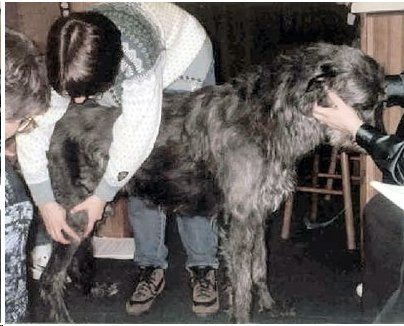
- By C.A. Krowzack, DVM In February of 1998, the Great Lakes Irish Wolfhound
Association (GLIWA) held their annual meeting. The meeting is an occasion
for fellowship of the members; the club attends to business and also
hosts a speaker on a special topic. In the past it has been obedience,
therapy dog training, and this year the topic was acupuncture. Dr.
Debbie Mitchell gave an overview of what acupuncture is, its history
and its medical uses. Then, using a member's dog showed the participants
several acupuncture/acupressure points that they could utilize. One
point was to stimulate gastrointestinal motility to combat bloat.
REFERENCES AND RESOURCES: For a list of all feed programs and articles referenced go to: wwwGreatDaneLady.com and click on ARTICLES and scroll through the titles to find what you are looking for be it Feed Programs for all sizes/shapes of dogs, Feed Programs for Rescue/Repair, Sensitive Stomach, IBS, IBD, etc. Supplement Links:
|
|
|
|
|About Us | Album
| Interview | Articles
| Links | Breeders
Showcase | GREAT Great Danes
| Linda's Artwork
| Email: Copyright © 2002-2003 GREATDANELADY.COM |